I Left My Heart with the War
The Project
Hello, friends.
This is Adam writing. When Brant asked me to write up a brief outline of how we made I Left My Heart with the War, I decided to make it as unbrief as possible.
I Left My Heart with the War, to be candidly explained, was made for no reason. It was born out of a fake soap opera briefly included in a student film made by Brant and myself (amongst others not appearing in this drama), and upon the suggestion of turning this ten second clip into a complete film, as a sort of last hurrah before our friends and ourselves all went our separate ways for college, we knew it would have to be a whopper—a tour de force. No one told us to make it; no one promised us anything mildly lucrative would come of it; in fact, as you’ll find out as you read on, it seemed unavoidable forces took measures to stump production of it.
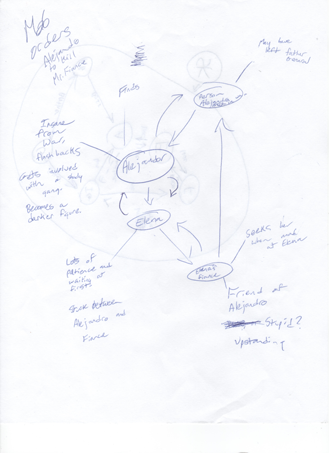
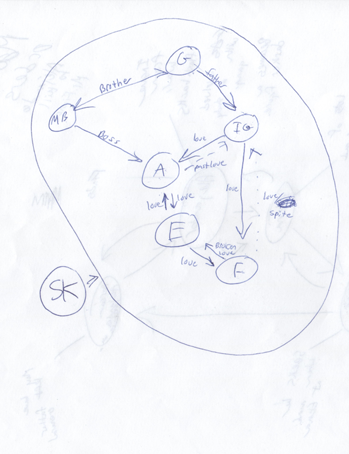
Yes—I Left My Heart started as an idea for a film. The minds of Brant, our friend Steven, and I met on a sunny afternoon to brainstorm the plot for this project, and after many hours of careful deliberation and crawling on the rug in search of plot, we had found our storyline. Here is the scatterbrained product of our thinking—a graphic unorganizer of sorts:
Because, of course, we knew that keeping ourselves in a single room for several hours to circle around one idea would only result in a sensible product.
I had been given the wondrous opportunity to write the script for I Left My Heart—and I do not say so sarcastically, because it’s one of the most interesting and fun things I’ve ever had to write. After weeks and weeks of scriptwriting, I turned the final piece in to Brant and Steven—a fat text file. They read it, and we all agreed to move forward. We spent more meetings deciding our cast, planning on materials and props needed to make it possible, and soon we were ready to begin filming.
Unfortunately, we had not correctly estimated the immensity of everything that came with making I Left My Heart, because though we were fully aware we were kids out of high school with very little resources, time, or sense, we decided it was still possible to make a great film. At its core, it would have done very well as a movie; we had a great story, we had the knowhow, we had the creative drive. Unfortunately, some of the key components to making a quality movie (as we had experienced it) were not available due to many circumstances. We were all going off to college, many of us were working, and inevitably, as a result, no one seemed to be available to film with us at ideal times. We also did not have the props or costumes, and none of us had the money to spend on these things. It was too grand of a project. We were afraid that our golden idea was dying before our eyes, and would burn out as we all parted ways to move on to bigger things in life.
But, to moving on to bigger things we said “Nay!” We all agreed to keep the project alive. I came to Brant with an idea: The script could be adapted into a radio drama, like the ones Orson Welles (and many others I don’t care to reference) did in the 1930s. In looking through the script, I Left My Heart would be perfect due to its heavy amount of dialogue and dramatic tone. It was unanimous—everyone was on board to take the script and try a medium none of us had experience in.
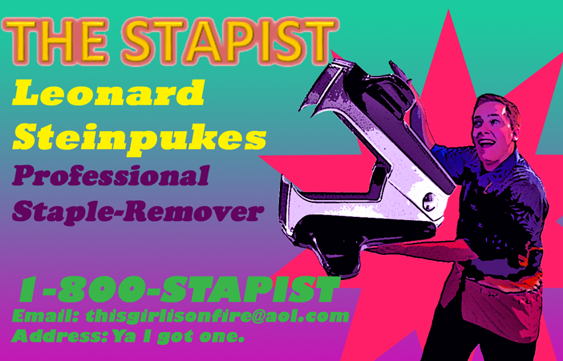
What was unfortunate about this change was the loss of visual comedy that would have complemented certain scenes so, so well. For instance, Leonard’s original business card:
Just as well, our copy of what I believe was considered an erotic novel (to serve as Rose’s piece of literature) had gone to waste, as well as the longest few seconds I have ever experienced in purchasing it in a thrift store from an old woman.
But, there were many virtues to the new project. Luckily, our actors were still on board and stuck with us through the process. I spent many more weeks adding narration and reworking the script, and this addition added another dimension to the story, and allowed us to get away with certain things we could not have done in the movie (for instance, Vinny’s wall-eyed glare and the fight between Rose and Madelena).
Brant was able to borrow high-quality microphones for the occasion, and we began recording. Brant worked the recording and diligently allowed the cast to goof off for most of the sessions. I admire the many hours he spent sifting through our recordings, digging from the many layers of giggles and misreads to find the golden nuggets of sound that were worth something. Some recordings intended for use were cut—no one outside of the cast will ever know the many sounds of Vinny (Spencer McFarland) that were left unused because they were so uncomfortably, unsettlingly hilarious.
Some problems arose from doing certain scenes—lines are read differently when there’s only a microphone and no camera or costume. We did our best to adapt to the change in setting, and we read and reread lines to a point that the jokes lost some of their spiciness. We brought in our friend Ben Fisher to record narration, as he was locally famous for his booming-yet-smooth voice. It was at this point I truly became excited for what we were doing.
When recording was finished, Brant sorted all our audio files and placed the dialogue together, which as I said earlier, was no easy task. He handed the file to me to get some sound effects for it—at this point it was late August—and due to the largeness of the file my computer was slowed immensely and the sound effect placing took far longer than it should have. It was now September, and college life was nearing. We knew we only had so much time left before we could not work on the project anymore. Brant and I put together the final bits of sound effects during a grueling, all-day session. It was at this point that, from all of the analyzing and replaying, the jokes had lost so much spiciness to us that our Joke-Curry of an audio drama had become Joke-Mayonnaise.
That night, Brant and Darren VanBuren worked hard to master it and made some final revisions, and, eventually, it was finished. We had completed the project that required so much work and time—all for no reason but to have fun. And I can safely say: It was worth it. It’s something different; it’s a medium that, after working in, I think deserves more attention. I hope you enjoy listening to it as much as we did making it.
Sincerely,
Adam Kane